12 — The Alloy Library: Proprietary Compositions

Metallic Sciences does not catalogue alloys by ASTM designation. Every alloy in the Library is a proprietary composition engineered for a specific Metallic Sciences application — named by internal MS series number and characterised by the problem it was designed to solve, not the elements it contains. The philosophy: the name of the alloy is the requirement it fulfils.
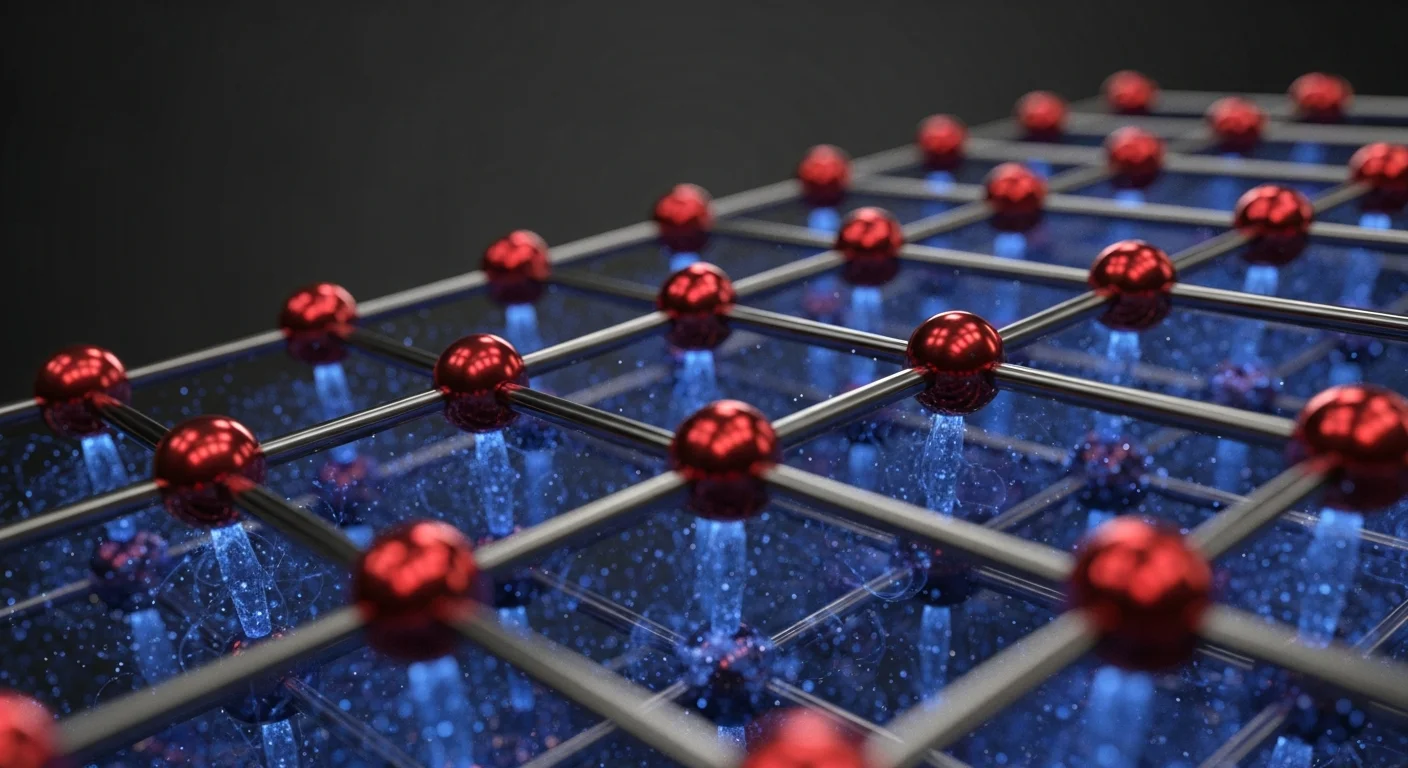
MS-7 is a gamma-TiAl intermetallic compound — a specific stoichiometric phase of titanium and aluminium where the two elements lock into an ordered superlattice rather than a random solid solution. Conventional titanium alloys lose half their yield strength above 600°C. MS-7 retains structural integrity to 850°C while delivering a density of 3.9 g/cm³ — barely above aluminium, half the weight of nickel superalloys currently used in the same temperature envelope.
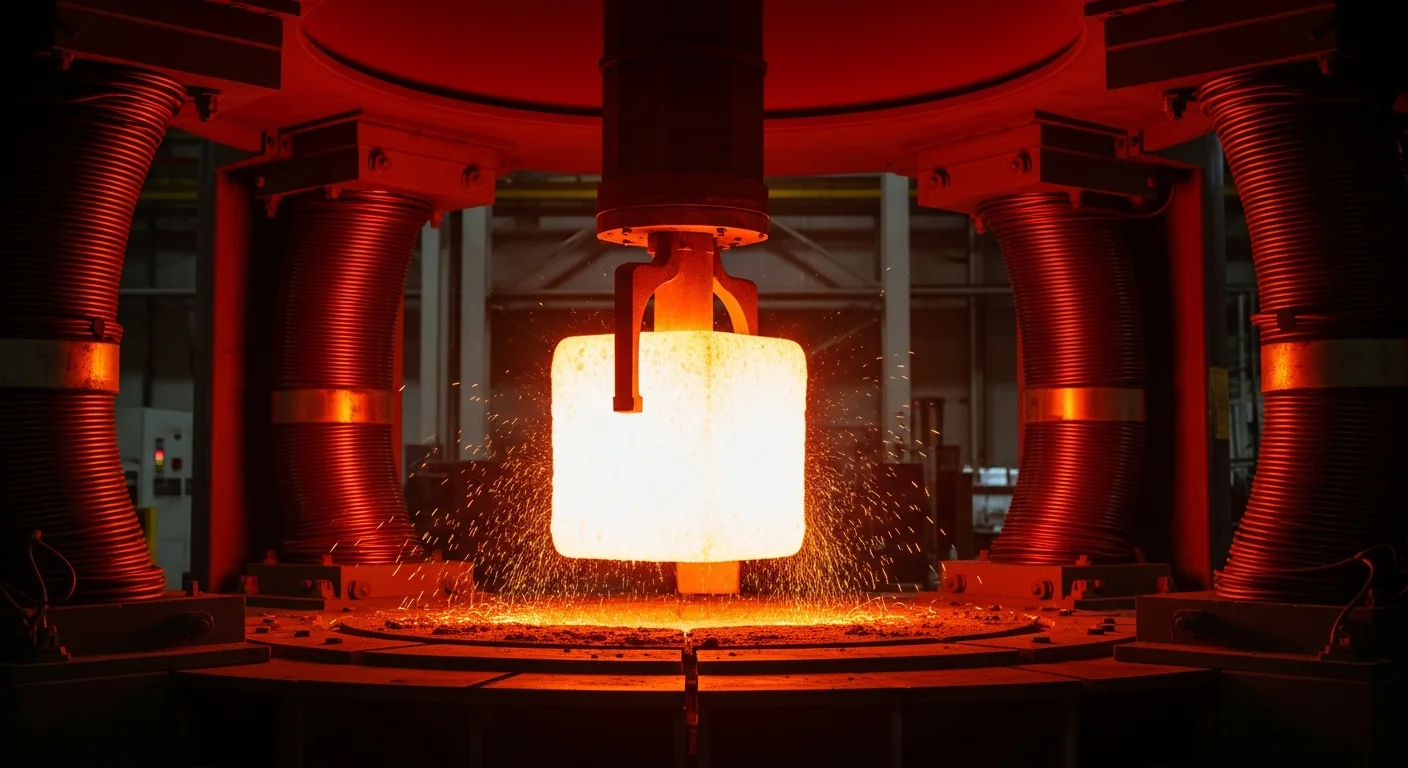
The alloy is produced via the Crystal Foundry using a modified Bridgman cycle tuned for lamellar colony alignment: the gamma/alpha-2 lamellar structure is oriented parallel to the primary loading axis, maximising creep resistance in the intended service geometry. Post-growth, the part undergoes hot isostatic pressing in the Ceramic Foundry to close any residual inter-lamellar porosity.
Application: Lorentz Aerospace low-pressure turbine blades and thrust chamber structural rings — stages where the temperature exceeds conventional titanium capability but does not demand the full weight and cost penalty of nickel superalloy. MS-7 saves approximately 38% mass in these stages versus the nickel baseline.
Density: 3.9 g/cm³. Service temperature ceiling: 850°C. Yield strength at 700°C: 480 MPa. Oxidation resistance: inherent Al₂O₃ scale. Production route: Crystal Foundry Bridgman + Ceramic Foundry HIP.
MS-12 is the Metallic Sciences implementation of the entropy-stabilised multi-principal-element alloy concept pushed to its engineering limit. The composition — a near-equimolar blend of tungsten, chromium, vanadium, titanium, and zirconium — is designed specifically around the irradiation damage environment of a fusion first wall: 14 MeV neutron flux, high surface heat loads (up to 5 MW/m²), and thermomechanical cycling over a 30-year service life.
The configurational entropy of the five-element lattice suppresses vacancy cluster formation under neutron bombardment — the mechanism by which conventional tungsten swells and embrittles. In MS-12, displaced atoms have a higher probability of finding a nearby site with near-equivalent energy, enabling spontaneous recombination rather than clustering. Irradiation swelling is reduced by a factor of 4–6× versus pure tungsten at equivalent fluence, based on in-pile testing at the Stellar Furnace research reactor.
The alloy is produced in the Vacuum Arc Foundry (triple-melt sequence for homogeneity) and machined to final panel dimensions by electron discharge machining — conventional cutting tools cannot handle the hardness without accelerated wear.
Composition: W-Cr-V-Ti-Zr (near-equimolar). Vickers hardness: 620 HV. Thermal conductivity: 22 W/m·K at 600°C. Irradiation swelling: <0.5% at 50 dpa. Service temperature: 300–1,100°C. Production route: VAR triple-melt.
Superconducting wire requires a substrate that is mechanically robust enough to survive winding and handling, chemically inert enough to not contaminate the superconductor interface, and dimensionally stable enough over 4 K to 300 K thermal cycling that it does not delaminate the superconducting layer. MS-19 is the answer: a W-26%Re composite produced in the Levitation Foundry to guarantee zero crucible oxide contamination at the substrate surface.
Rhenium additions to tungsten suppress the ductile-to-brittle transition temperature from +200°C (pure W) to below −100°C in the W-26Re regime — making the wire drawable and windable at room temperature rather than requiring hot processing. The Levitation Foundry's cold-wall skull melting ensures the W-Re ratio is homogeneous to within ±0.3 wt% across the ingot cross-section: critical because Re gradients create local variations in the DBTT that cause wire fracture during coil winding.
Application: Substrate tape for REBCO coated-conductor fabrication at Highfield Magnetics. MS-19 tape is slit to 4–12 mm width, electropolished to Ra <0.1 µm, and shipped on precision spools for REBCO buffer stack deposition.
Composition: W-26Re. DBTT: <−100°C. Density: 19.7 g/cm³. Surface finish (as-slit): Ra <0.1 µm. Re homogeneity: ±0.3 wt% across ingot. Production route: Levitation Foundry (cold-wall skull melt) + precision rolling.
ALON-X is the production formulation of the Parabola Glass transparent armor system — a compositionally optimised aluminium oxynitride spinel (Al₂₃O₂₇N₅) produced via hot isostatic pressing in the Ceramic Foundry. The "X" designation denotes the extended-clarity formulation: a tightened powder purity specification (99.995% Al₂O₃ precursor, nitrogen-controlled sintering atmosphere) and a modified two-stage HIP profile that eliminates the residual porosity responsible for haze in conventional ALON production.
The result: 85% optical transmission (photopic) at 50 mm panel thickness. This specification is the threshold for practical use as a ship viewport — the human visual system can adapt to the slight tint, whereas haze (Mie scattering from sub-micron pores) is not correctable. ALON-X tiles pass this threshold; standard commercial ALON grades do not at this thickness.
Ballistic performance: ALON-X at 50 mm defeats 7.62×63 mm AP (M2) threats in conjunction with a glass-glass backing laminate. Panel weight: 102 kg/m² at 50 mm — equivalent areal density glass-ceramic would be 180 kg/m².
Composition: Al₂₃O₂₇N₅ (spinel). Optical transmission: 85% at 50 mm. Hardness: 2,000 HV. Fracture toughness: 2.1 MPa·m½. Density: 3.69 g/cm³. Ballistic: MIL-PRF-32432 Level IV equivalent. Production route: Ceramic Foundry HIP at 1,800°C / 200 MPa.
All conventional materials expand when heated and contract when cooled. This creates thermal stress at interfaces between components of different materials — the bimetal problem — and sets precision limits on instruments, optics, and dimensionally critical structures. FERRO-C is a carbon-iron metamaterial with engineered negative thermal expansion (NTE): it contracts when heated and expands when cooled, over a controllable temperature range.
The mechanism is not a material property of iron or carbon individually but an emergent geometric effect. Carbon nanotube struts — grown in the C-Forge to precise chirality and length specification — are arranged in a re-entrant lattice geometry and bonded into an iron matrix via the Ceramic Foundry CVI process. When the temperature rises, the nanotube struts pull the iron nodes inward rather than pushing them outward: macroscopic NTE from microscopic geometry.
By adjusting the nanotube strut geometry, the coefficient of thermal expansion can be tuned continuously from +8 × 10⁻⁶/K (conventional steel) through zero (invar-equivalent) to −5 × 10⁻⁶/K. Zero-CTE panels are used in Aetheric Sciences photonic chip packaging; NTE panels are used as passive compensators bonded to positive-CTE structures to produce net-zero assembly expansion.
Application: Precision optical mounts for Maxwell Continuum laser systems (where thermal drift of 1 µm in beam path length is unacceptable). Dimensionally stable structural frames for Aetheric Sciences quantum computing substrates. Phase Flash cryogenic heat-exchanger bonding layers, where the NTE behaviour is exploited at cryogenic temperatures.
CTE range (tuneable): −5 to +8 × 10⁻⁶/K. Matrix: iron (Fe). Reinforcement: CVD carbon nanotubes (re-entrant geometry). Density: 4.2–5.8 g/cm³ (geometry-dependent). Production route: C-Forge CNT growth + Ceramic Foundry CVI iron infiltration.
| ALLOY | SYSTEM | KEY FEATURE | PRIMARY CUSTOMER | FOUNDRY |
|---|---|---|---|---|
| MS-7 | Ti-Al intermetallic | 3.9 g/cm³, stable to 850°C | Lorentz Aerospace | Crystal + Ceramic |
| MS-12 | W-Cr-V-Ti-Zr HEA | 4–6× less irradiation swelling vs pure W | Stellar Furnace | Vacuum Arc (VAR) |
| MS-19 | W-26Re composite | DBTT <−100°C, Ra <0.1 µm | Highfield Magnetics | Levitation |
| ALON-X | Al₂₃O₂₇N₅ spinel | 85% transmission at 50 mm, MIL IV | Lorentz / Modular Habitats | Ceramic (HIP) |
| FERRO-C | CNT-Fe metamaterial | CTE tuneable −5 to +8 × 10⁻⁶/K | Maxwell / Aetheric / Phase Flash | C-Forge + Ceramic |