Metallic Sciences
HIGH-PERFORMANCE ALLOYS & STRUCTURAL SUBSTRATE
METALLIC SCIENCES
Metallic Sciences supplies the metal skeleton for systems that operate at the edge of what materials can survive. The Triazite tungsten-rhenium-hafnium-carbide alloy stack is the flagship product line: refractory enough for Stellar Furnace anode tips at the muzzle of a 100,000-pulse-per-second discharge, structural enough for the Lorentz Aerospace XR-1 outer skin at Mach-7 stagnation conditions, conductive enough to carry pulsed current through the Highfield God Magnet array. Each application demands a different alloy variant; the discipline is the engineering of those variants against a shared metallurgical process platform.
Conventional alloy engineering treats metals as commodity stock with specified mechanical properties. Metallic Sciences treats metals as engineered operating media tuned to a specific extreme — pulsed thermal load, sustained creep, magnetic compatibility, oxidation resistance under plasma exposure. The alloy is the input, not the product; the product is the operating envelope it enables.
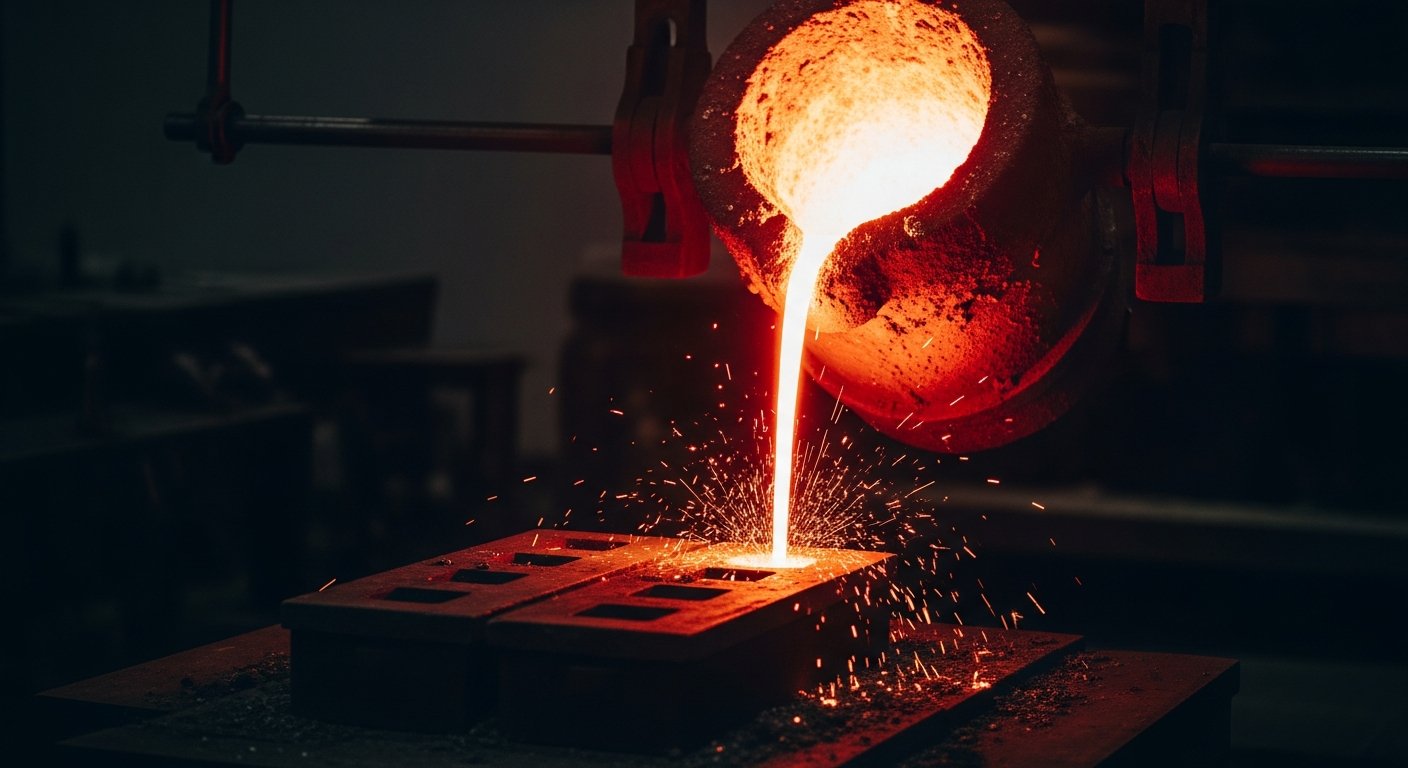
We do not sell metal. We sell operating envelopes. Each alloy variant is engineered for one extreme; the variant is the deliverable.
01 — The Discipline

ALLOY LIBRARY
An engineered alloy is a metallurgical recipe: a base metal (or set of base metals), a specific concentration of substitutional or interstitial elements, a thermomechanical processing history that determines the grain structure, and a surface treatment that adapts the bulk to its operating environment. The mechanical, thermal, electrical, and corrosion properties of the finished alloy are a function of all four together; changing any one alters the operating envelope.1
Metallic Sciences engineers alloys across four practical product families: refractory metals for ultra-high-temperature service (Stellar Furnace anodes, hypersonic leading edges, plasma-facing components); high-entropy alloys for combined thermal-mechanical-corrosion service (Phase Flash pressure vessels, brine-handling manifolds); superalloys for sustained creep service (rotating-element subsystems in legacy turbomachinery the network ships into); and electrically-engineered metals for pulsed-current and magnetic-compatibility service (Highfield Magnetics bus bars, pulsed-power capacitor straps, Cu-Ag-steel composite conductor for God Magnet pulsed array).2
The discipline is metallurgy as a system service. The deliverable is not the alloy ingot but the engineering-envelope-plus-alloy-plus-process-plus-surface package that lets a customer system operate where conventional steel, copper, aluminium, or titanium would fail. The competitive moat is the chemistry library, the thermomechanical processing know-how, and the in-house verification suite that proves operating-envelope claims at customer-relevant cycle counts.
02 — The Bottleneck
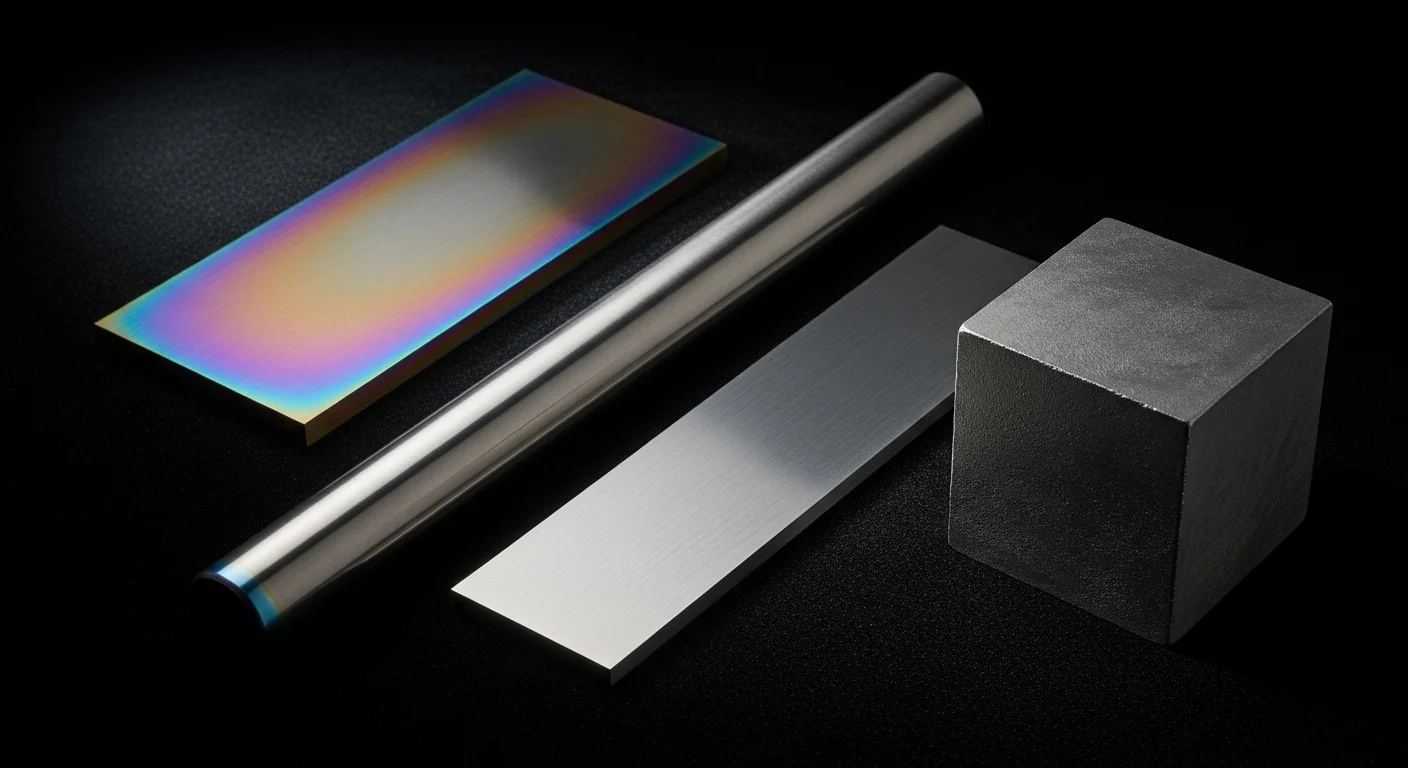
ALLOY SPECTRUM
Conventional steels, copper alloys, aluminium alloys, and titanium alloys cover most industrial demand because the chemistry-and-processing space is well-trodden, the standards bodies have certified the safe envelopes, and the unit economics of high-volume primary metallurgy crush exotic alternatives. Where these alloys stop is the same place the rate of every high-energy industrial system stops: at the leading edge of a hypersonic vehicle, in the first wall of a fusion reactor, at the anode of a pulsed-power discharge, in the magnetic core of a high-cycle inductor. Below 1100°C, conventional alloys win on cost. Above 1100°C, conventional alloys lose — they creep, oxidise, soften, deform, ablate.3
The refractory metals (tungsten, rhenium, molybdenum, niobium, tantalum, hafnium) extend the temperature envelope to 2500°C and beyond. They are expensive, difficult to machine, and brittle at room temperature — the engineering challenge is alloying them to retain ductility and to bond them to lower-temperature structural subsystems without thermal-mismatch failure. The high-entropy alloy literature of the last two decades has produced multi-principal-element alloys (five or more elements in roughly equal molar concentration) with combinations of mechanical strength, thermal stability, and corrosion resistance that no conventional binary alloy can match. The two threads converge in the Triazite product family.4
The deeper bottleneck is verification. A new alloy variant requires thousands of hours of cyclic operation in instrumented test rigs before it can be shipped into a critical-path machine. Standard creep tests run for 10,000+ hours; oxidation tests for 5,000+; pulsed thermal-fatigue tests for millions of cycles. The Metallic Sciences moat is not just the chemistry but the in-house test infrastructure that runs these verification cycles in parallel across the alloy library.
03 — The Alloy Stack
ATOMIC LATTICE
Four alloy families span the practical product line. Each is a complete deliverable: composition + processing + surface treatment + verified operating envelope, not just a recipe.
Tungsten-rhenium-hafnium-carbide alloy stack for ultra-high-temperature service. Three named variants: Triazite-A (anode-grade, 50% W / 25% Re / 25% HfC for pulsed-discharge erosion resistance), Triazite-S (skin-grade, 70% W / 20% Re / 10% HfC for sustained-thermal-flux service like hypersonic leading edges), and Triazite-C (composite-grade, 60% W / 30% Re / 10% HfC for thermally-cycled structural fittings). Service envelope: continuous operation up to 2400°C, pulsed peak to 3200°C, oxidation-resistant in non-reducing atmospheres for 5000+ hours.5
Five-element equiatomic alloys for combined thermal-mechanical-corrosion service where no single-principal-element alloy can satisfy all three constraints. The base composition is Cr-Fe-Ni-Mn-Co with adjustable minor additions for specific applications: Co-rich variant for radiation environments, Mn-rich for cryogenic toughness, Fe-Ni-rich for magnetic compatibility. Service envelope: up to 800°C continuous, corrosion-resistant in chloride and acid environments, cryogenic-tough to 20 K.6
Nickel-base superalloy product line for sustained creep service in legacy rotating turbomachinery the network ships into. Mature chemistries (Inconel 718, Rene 95, CMSX-4) with proprietary processing improvements: directional solidification grain control, dispersion-strengthened oxide additions, single-crystal casting for turbine blade applications. Service envelope: 1100°C continuous with creep life beyond 50,000 hours at design stress.
Cu-Ag-steel composite conductor for Highfield Magnetics pulsed-magnet applications. Copper carries the bulk current; silver inclusions improve thermal conductivity at the surface; steel reinforcement holds the conductor against the Lorentz hoop stress. Three variants: God Magnet pulsed grade (8 kA/mm² peak current density, 10⁶-pulse fatigue life), Iron Horse continuous grade (1 kA/mm² continuous, sustained service), and Bus Bar grade (high-conductivity copper-only for low-loss steady-state current distribution).7
04 — Thermal and Electrical Infrastructure
C FORGE
The alloy is upstream of the engineered hardware piece. Each family ships as named structural product configurations whose roles in the network's flagship machines are explicit:
Each configuration is a separately-tracked product. Alloy chemistry, processing recipe, surface treatment, and verified operating envelope are documented per configuration; customer orders specify the configuration code, not the alloy chemistry. The product structure decouples the upstream metallurgy from the downstream application engineering.
05 — Manufacturing and Joining
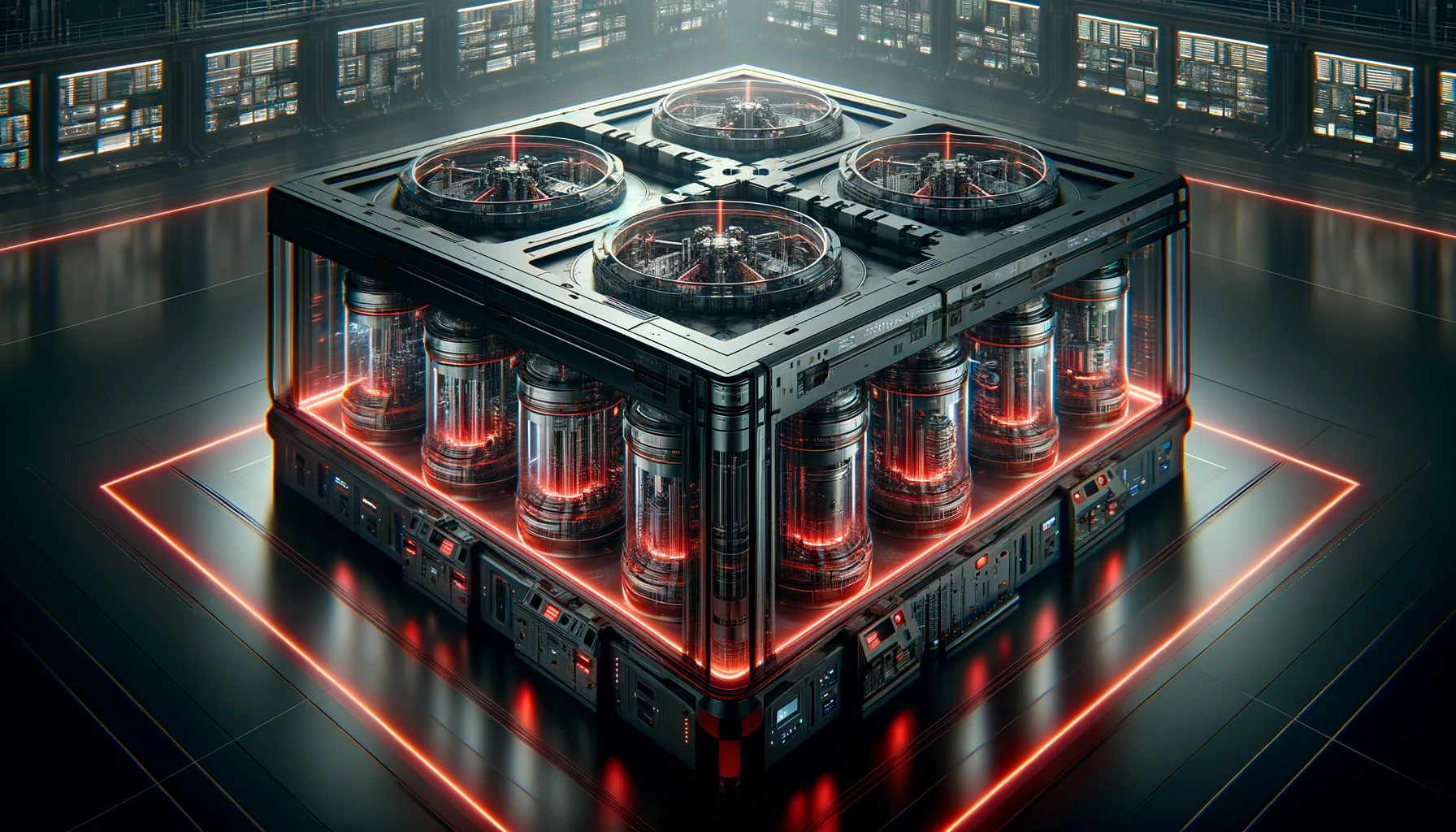
CFORGE OMEGA CELL
The metallurgy upstream of the alloy ingot is conventional industrial practice: vacuum induction melting, directional solidification for single-crystal casting, hot isostatic pressing for void-free consolidation, powder metallurgy with subsequent compaction for the refractory families. The downstream forming, machining, and joining are where the discipline differentiates.
Additive metal printing. Selective laser melting and electron-beam powder-bed fusion ship the Triazite refractory family as near-net-shape components. The technology is mature for most superalloys; refractory metals are harder because powder feedstock is more expensive and process windows are narrower. The Metallic Sciences additive line uses recycled-powder feedstock and in-process layer-by-layer pyrometry to maintain print quality on tungsten-base alloys at production volume.8
Diffusion bonding for refractory-to-structural joints. The Triazite outer-skin panels on the Lorentz XR-1 must bond to a high-strength steel or titanium substructure inboard. The thermal-expansion mismatch is severe; conventional brazing fails on the first thermal cycle. The diffusion-bonding process at 1100°C with controlled interlayer chemistry produces a gradient-composition joint that distributes the mismatch over a millimetre-scale interphase region. Joint shear strength at room temperature exceeds 350 MPa and survives 1000+ thermal cycles from 20 K to 1500°C.9
Powder metallurgy for cryogenic-tough HEA. The high-entropy alloy family is consolidated by powder metallurgy with mechanical alloying to ensure compositional homogeneity at the micrometre scale. Compositional uniformity is the key to cryogenic toughness; conventional ingot metallurgy produces dendritic segregation that breaks cryogenic ductility. The mechanically-alloyed powder is HIP'd into billet stock and machined to final dimensions.
Robotic finishing. Foundation Kinetics's Scarab class of compact actuators handles the precision finishing operations — grinding, deburring, surface treatment application — for Metallic Sciences components at sub-micrometre tolerance. The joint Metallic-Foundation cell is one of the network's most-cross-discipline manufacturing integrations.
06 — Supplier & Integration Partners
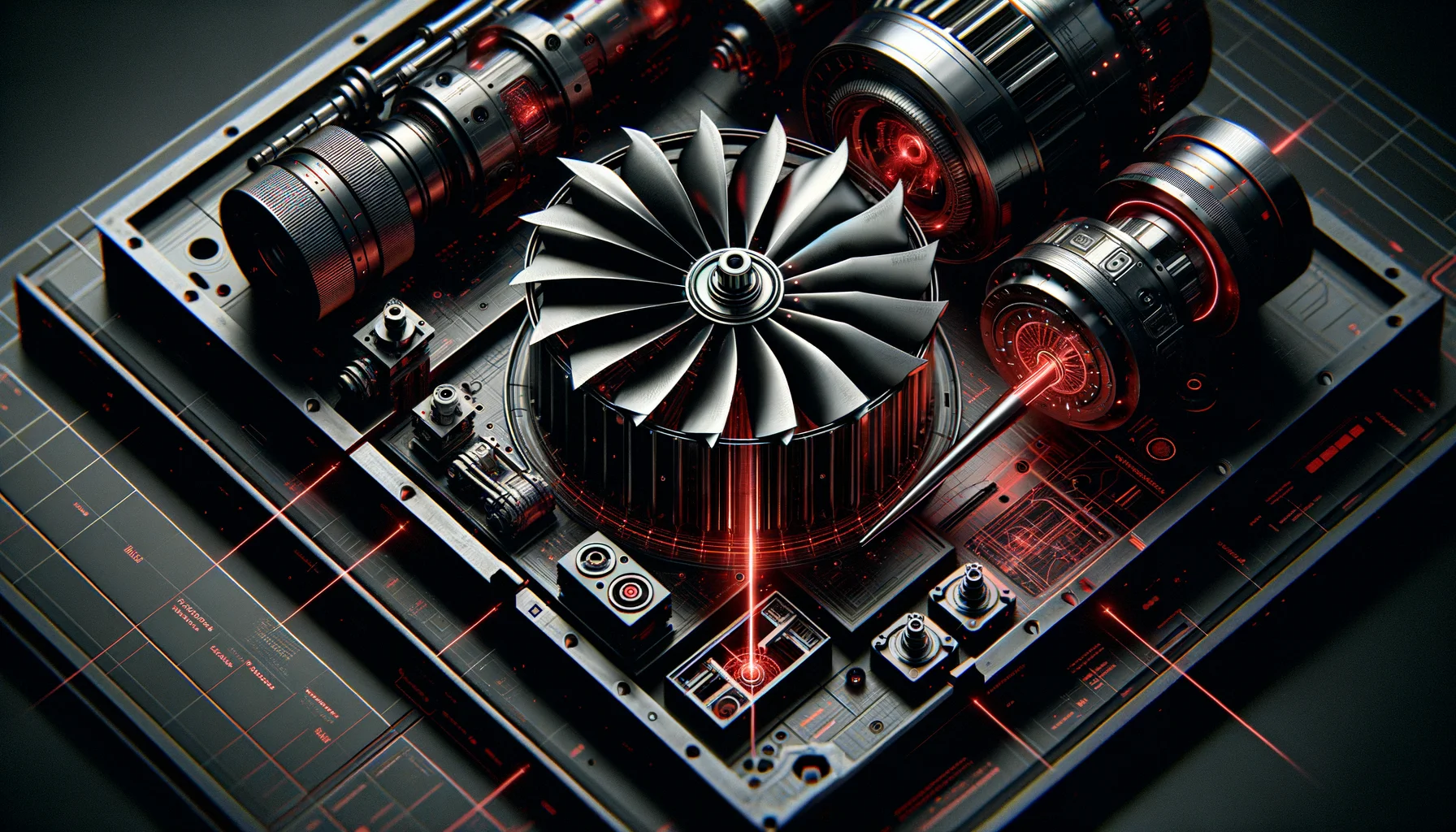
INTEGRATION MS
Metallic Sciences ships into seven peer companies as the structural and thermal substrate for their flagship machines. The supplier-and-integration stack is the engineering of the alloy-to-application chain.
Stellar Furnace — Triazite-A anode tip inserts for the SF-1 dense plasma focus muzzle. Beryllium-lithium converter shells for the traveling-wave direct converter. OFC copper electrode bodies. Hardened-steel pulsed-power capacitor strap.
Highfield Magnetics — HEA structural reinforcement for the Iron Horse twenty-tesla coil over-wrap. Pulsed-conductor Cu-Ag-steel composite for the God Magnet pulsed array. Cryogenic-rated bus bar stock for the warm-to-cold conduction stack.
Lorentz Aerospace — Triazite-S outer-skin panels for hypersonic stagnation regions. CNT-composite structural fibre for the body lattice. Refractory leading-edge tile inventory for the Class B hypersonic boundary-layer demonstrator.
Phase Flash — HEA pressure vessels for the Oasis chamber. Triazite-C poppet-valve seats. Corrosion-resistant manifold stock for the brine-handling subsystem.
Plasma Press — Precision-machined OFC copper electrode bodies, stainless cold-trap surfaces, magnetic-bearing rail stock for the substrate-positioning stage.
Matter Kitchen — Corrosion-resistant chamber bodies for the volumetric-cooking platform. High-Q microwave-reflector geometry alloy stock.
Foundation Kinetics — Direct-drive actuator rotor stock (precision-cast permanent-magnet rotor laminations). Hardened steel rail stock for Scarab positioning systems. Joint-development of additive-metal cell automation.
Fermat Logistics — Largest recurring sigma-1 standard-cargo flow in the network: weekly MS-7 titanium billet convoys to Lorentz Aerospace + refractory ingot shipments to Stellar Furnace.
Stellar Furnace → Highfield Magnetics → Lorentz Aerospace → Phase Flash → Plasma Press → Matter Kitchen → Foundation Kinetics → Fermat Logistics →
07 — Validation Hooks
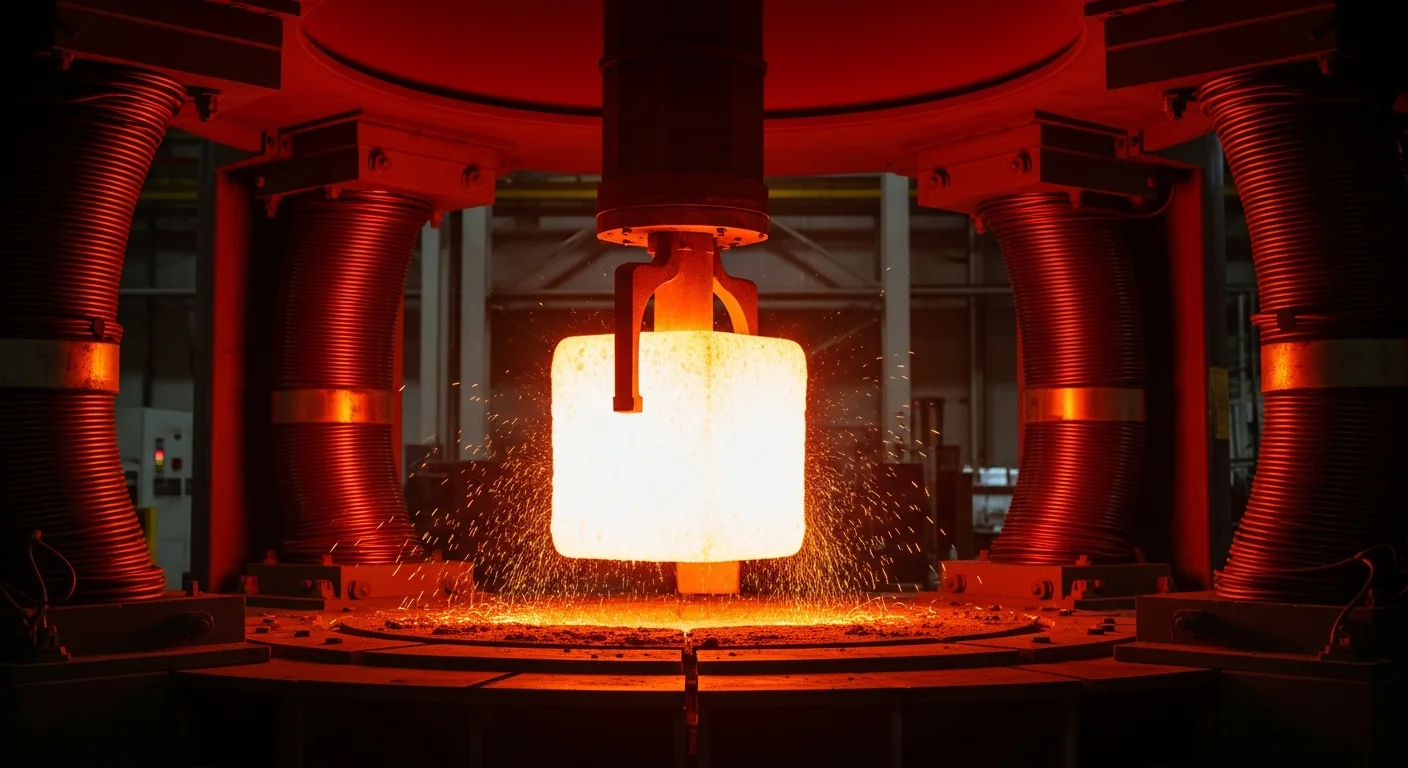
CFORGE OMEGA
Four measurable claims define the forward roadmap. Each is intended to be a future Crystal Ball-grade prediction registration once the prediction infrastructure exists.
HOOK A — Triazite-A anode life beyond 10⁷ pulses. The current Triazite-A pulse-fatigue life is roughly 10⁶ pulses at SF-1 design discharge conditions, equivalent to about six hours of continuous SF-1 operation between relining cycles. The forward target is 10⁷ pulses (sixty hours), extending the maintenance interval enough to make SF-1 commercially viable. The gating measurement is sustained discharge testing in a representative pulsed-power rig at design current density without measurable erosion-rate increase across the longer cycle count.10
HOOK B — high-entropy alloy oxide-dispersion variant for radiation service. The forward research target is a Cr-Fe-Ni-Mn-Co high-entropy alloy with stable nanoscale oxide dispersions for radiation-environment service. Applications include next-generation fission reactor structural materials, fusion-blanket structural components, and accelerator-target backings. Demonstration of sustained oxide stability under 10 displacements-per-atom neutron flux is the gating measurement.11
HOOK C — additive refractory at production volume. Selective laser melting of tungsten-base alloys is currently constrained by powder feedstock availability and process yield. A forward target is reliable additive printing of Triazite components at 80 percent material yield from feedstock powder over multi-ton production volumes. Demonstration of a 1000-component production run from a single feedstock lot with statistically-controlled property variation is the gating measurement.
HOOK D — cryogenic-to-1500°C diffusion-bonded joint with 1000+ thermal cycles. The current diffusion-bonded joint at the Lorentz hull stagnation region is rated for 1000 thermal cycles from 20 K cryogenic to 1500°C surface temperature. Extension to 10,000 cycles would push the XR-1 platform service interval to a full operational year. The gating measurement is a representative test article cycled in a representative thermal-vacuum chamber at design loads.12
RESEARCH REPOSITORY
Metallurgy, refractory systems, high-entropy alloys, additive manufacturing, thermal management, and fusion/aerospace materials.
Metallic Sciences is the engineering of metals as operating-envelope-defining substrate for high-energy systems. Four product families — Triazite refractory, high-entropy alloy suite, superalloy legacy, pulsed-electrical conductors — ship into the network's flagship machines as the structural, thermal, and electrical skeleton. The discipline is the verification of alloy operating envelopes at cycle counts customer machines actually demand: 10,000-hour creep, 5,000-hour oxidation, 10⁶-cycle thermal fatigue, 10⁶-pulse pulsed-conductor fatigue.
(wiki) Refractory Metals • (wiki) Tungsten • (wiki) Rhenium • (wiki) Hafnium Carbide
Reference Links — High-Entropy Alloys(wiki) High-Entropy Alloys • (wiki) Cantor Alloy • (wiki) Mechanical Alloying
Reference Links — Additive Manufacturing(wiki) Selective Laser Melting • (wiki) Electron Beam Melting • (wiki) Hot Isostatic Pressing • (wiki) Directional Solidification
Reference Links — Thermal Management & Fusion Materials(wiki) Creep Deformation • (wiki) Thermal Fatigue • (wiki) Superalloy • (wiki) Plasma-Facing Material
- Lassner, E. & Schubert, W.-D. Tungsten: Properties, Chemistry, Technology of the Element, Alloys, and Chemical Compounds. Springer, 1999. ISBN 978-0-306-45053-2.
- Reed, R.C. The Superalloys: Fundamentals and Applications. Cambridge Univ. Press, 2006. ISBN 978-0-521-85904-2.
- Murty, B.S. et al. High-Entropy Alloys. 2nd Ed. Elsevier, 2019. ISBN 978-0-128-16067-1.
- Gibson, I., Rosen, D., & Stucker, B. Additive Manufacturing Technologies. 3rd Ed. Springer, 2021. ISBN 978-3-030-56126-0.
- Lemaitre, J. & Chaboche, J.-L. Mechanics of Solid Materials. Cambridge Univ. Press, 1990. ISBN 978-0-521-32853-1.
- Cantor, B. et al. "Microstructural development in equiatomic multicomponent alloys." Mater. Sci. Eng. A 375–377, 213–218 (2004). The founding high-entropy-alloy paper.
- Senkov, O.N. et al. "Mechanical properties of Nb25Mo25Ta25W25 and V20Nb20Mo20Ta20W20 refractory high-entropy alloys." Intermetallics 19, 698–706 (2011). Refractory HEA reference.
- Mathaudhu, S.N. et al. "Microstructures and recrystallization behavior of severely hot-deformed tungsten." Mater. Sci. Eng. A 503, 28–31 (2009).
- Pollock, T.M. "Alloy design for aircraft engines." Nat. Mater. 15, 809–815 (2016). The reference paper for engineered alloy design.
- ● Alloy as composition+processing+surface system: standard metallurgical engineering. Each variable independently affects the operating envelope; the discipline is integrated optimization.
- ● Four alloy product families: program structure. The chemistry libraries within each family are extensible; the family boundaries are operational/marketing rather than fundamental physics.
- ● Conventional alloy temperature ceiling: standard metallurgical data. Above ~1100°C the practical superalloy envelope closes and refractory metals become mandatory.
- ● High-entropy alloy convergence with refractory metals: active research program; multiple lab demonstrations of multi-principal-element refractory alloys exist. Industrial-volume Triazite is the engineering work.
- ● Triazite-A operating envelope: program target. Constituent metallurgy of W-Re-HfC is documented; integration as a productionised product family is the engineering scope.
- ● Cantor-alloy HEA family: standard high-entropy-alloy reference. Cryogenic toughness and corrosion resistance are documented properties.
- ● Cu-Ag-steel pulsed conductor: standard pulsed-magnet conductor architecture. Demonstrated at multiple national-laboratory pulsed-power facilities.
- ● Additive refractory production: engineering work in progress. Tungsten-base SLM has been demonstrated at lab scale; productionisation depends on feedstock supply chain.
- ● Diffusion-bonded refractory-to-steel joint: standard joining technology adapted for the specific thermal-mismatch envelope; engineering target for cycle life beyond 1000.
- ● Triazite-A anode life: program target. SF-1 commercialization depends on this hook.
- ● Oxide-dispersion HEA for radiation service: theoretical extrapolation from well-established oxide-dispersion-strengthened (ODS) steel; HEA-based variant is research target.
- ● 10,000-thermal-cycle joint: extension target; current 1000-cycle demonstration is the engineering baseline.